GreenLeap™ · AI‑native mine simulation
Match the materials handling system to the mine before you commit.
The costly mistake is not the wrong truck. It is committing to the wrong materials handling system, the wrong fleet or the wrong mining method. GreenLeap gives you the confidence to make these decisions. State-of-the-art, physics-based simulation, open pit and underground.
The questions it answers
The big decisions, on evidence.
Fleet, battery, charging, grid, mine plan and real-world variability are usually assessed one at a time. The value sits in how they interact. GreenLeap models them together.
Shaft or decline haulage?
Hoisting, decline trucking and conveying compared over the life of mine, on throughput, energy and cost.
Single or twin declines?
Traffic, passing, queueing and road rules tested on the real geometry, so decline capacity is measured, not assumed.
How many trucks?
Fleet size to meet the plan, with traffic, queueing, shift change and downtime included. Not average cycle times.
What type of trucks?
Any OEM and any truck class. Diesel, battery-electric, hybrid, trolley and biofuel, on the same mine, schedule and road network.
When are they needed?
Fleet and infrastructure requirements year by year as the mine deepens and the schedule changes, so purchases are timed to need.
Will the mine reach its throughput capacity?
Simulated tonnes against plan, with the governing bottleneck identified, and where it moves when you relieve it.
How efficient are the loaders?
Loader cycles from stope to truck loading bay: tramming, waiting for trucks, and the interaction between loading and haulage.
What charging and power do we need?
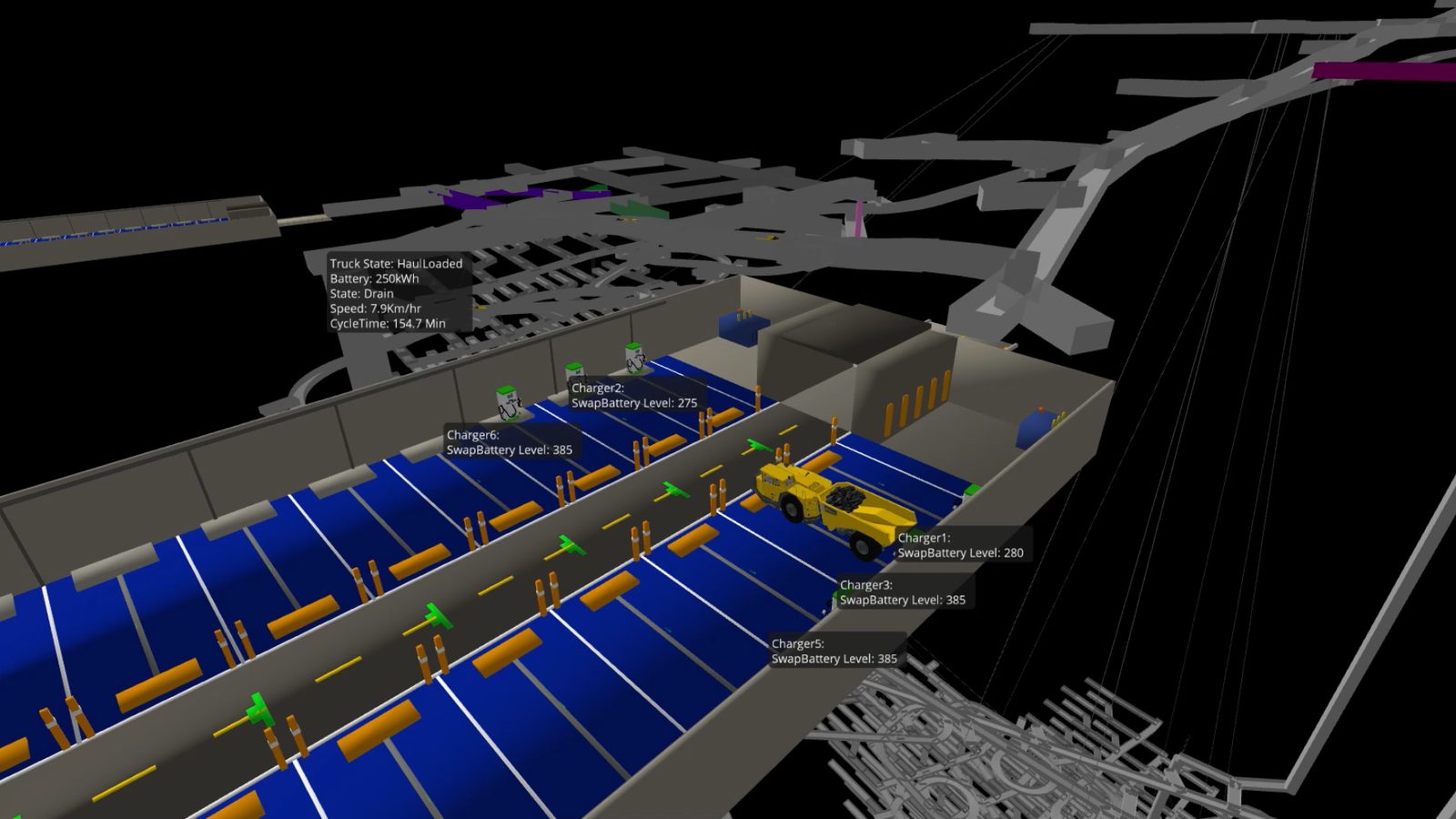
Static and dynamic charging, station placement, battery sizing, power demand, storage and grid, sized against real arrival patterns.
Also: ventilation heat by fleet option, road trains and rail, productivity uplift, total cost of ownership, NPC and NPV.
What the model shows
Findings a spreadsheet would miss.
Typical results from GreenLeap studies across underground and open pit mines. Figures are rounded and generalised to protect client confidentiality.
The system decided the fleet.
Choosing the right materials handling system, where to hoist, convey or truck, cut the truck fleet by around half for the same tonnes. No truck choice came close.
More trucks did not buy more tonnes.
Adding 40% more trucks lifted output by less than 10%. Loading points, passes and declines set the ceiling. The model found it before the trucks were bought.
Most of the loss was in how the mine runs.
Nearly half of truck time went to waiting and shift change. Changing operating practice was worth more than changing equipment.
Electrification is a system decision.
Depending on the system, a battery fleet needed up to twice the trucks to meet the same plan. The business case sits in fleet size, charging, power and the mine design together.
Less heat changes the ventilation case.
Battery trucks put around a quarter of the heat into the mine. That flows straight into ventilation and cooling, a cost often left out of the electrification case.
Most low-carbon options also cut cost.
With a carbon price applied, most electrified options cost less than diesel over the life of mine. The question is which one, not whether.
Try it
Add trucks. Watch the tonnes.
Every system has a ceiling. Past it, each extra truck adds queueing, not tonnes. GreenLeap finds where that point sits on your mine.
Illustrative curve. Real results come from a calibrated model of your mine.
The platform
From the face to the plant. One model.
A discrete-event, physics-based model of the whole materials handling system, underground and in the pit. Gradients, traffic, queueing, shift change and downtime, not static productivity factors.
Client feedback
What clients told us.
Several engagements have moved on to a second work package.
Without GreenLeap they would not have convinced the project steering committee to choose trucking over the shaft option.
Global diversified miner
They had not seen another system that can combine underground haulage, ore passes, overland haulage and a mixed fleet in one model.
Underground gold producer
Impressed by how easily GreenLeap adapts, and rated it the best simulation they have seen.
Tier 1 miner
Simulation at scale.
Full-scale, physics-based mine simulation has been slow to build, expensive and dependent on specialists. GreenLeap is built to change that, so more operators can test more decisions, earlier.
Built from your data
Mine plans, geometry and fleet data become a working model far faster and at far lower cost.
Scenarios at scale
Many more options tested across the life of mine, not the handful a study budget allows.
Physics underneath
AI speeds up the work. The answers still come from physics-based simulation you can check.
Contact
Let’s model it.
Send us a mine plan, a road network and the fleet specifications. We will tell you where the time, the energy and the money are going.